How Tokenization Will Reshape Real Estate
Why the next great transformation of property may not be architectural, but financial
Why the next great transformation of property may not be architectural, but financial
There are moments when an industry does not simply progress. It changes vocabulary.
I believe real estate is approaching one of those moments.
For centuries, property has embodied solidity, permanence, prestige and power. It is one of the oldest and most respected stores of value in the world. And yet, as an investment class, it has remained surprisingly rigid: high entry barriers, heavy administration, slow transfers, fragmented structures and limited liquidity.
Tokenization enters this world with a proposition that is far more profound than technology for technology’s sake. It suggests that while the building remains physical, the ownership architecture around it can become more fluid, more divisible, more transparent and more global.
That is why this subject deserves serious attention.
What tokenization actually is
At its essence, tokenization is the digital representation of an asset, or of rights linked to that asset, on distributed ledger infrastructure. The OECD describes asset tokenization as the digital representation of physical assets on distributed ledgers, or the issuance of traditional asset classes in tokenized form. Real estate is explicitly included among the asset classes to which this logic can apply.
In real estate, this usually does not mean that the physical title itself suddenly becomes a free-floating digital object detached from law, regulation or jurisdiction. More often, it means that an economic interest connected to the asset - equity in a holding structure, participation in a fund, exposure to a loan, or another property-linked right, is represented through digital tokens. This is a crucial distinction, because serious tokenization is not about escaping structure; it is about modernizing it.
Copyright Rosengart - All Right Reserved
What it really means
The most intelligent way to read tokenization is this:
It is not the dematerialization of real estate. It is the re-engineering of access to real estate.
And that may become a major shift.
Because what has historically limited real estate is not only the asset itself. It is also the friction around it: how capital is assembled, how interests are divided, how participation is recorded, how transfers are executed, and howmoder,iz investors enter or exit a structure.
Tokenization has the potential to redesign that layer.
Not the soul of the asset. Not the importance of location. Not the value of architecture. Not the discipline of execution.
But the financial grammar around ownership.
Why the idea is powerful
The appeal is immediately visible.
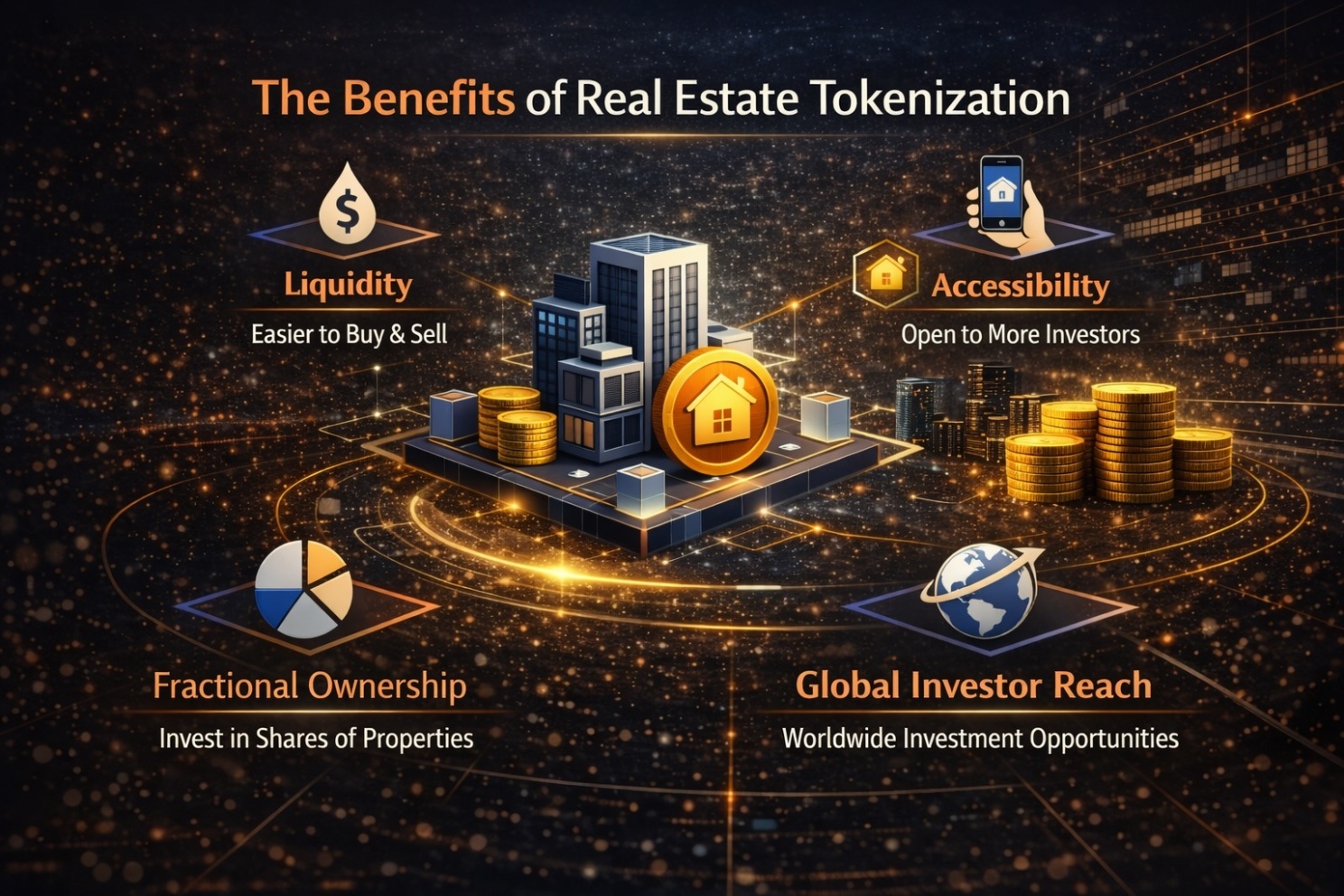
First, tokenization enables a more granular form of participation. A high-value asset no longer needs to be approached only through a single large capital commitment. It can be divided into smaller digital units, opening the door to fractional ownership and more flexible allocation strategies. Dubai Land Department has framed this explicitly as a mechanism to diversify ownership and allow multiple investors to co-own a single property through tokenized real-estate assets.
Second, tokenization can improve operational efficiency. Deloitte argues that tokenized real estate can help reduce administrative inefficiencies, lower costs and expand the investor base, while potentially creating trillions of dollars of new activity in the sector over the next decade.
Third, it can widen access to high-quality real estate opportunities. That does not diminish the asset; on the contrary, it may allow the best assets to connect with a broader and more international capital base, under better structured and more transparent frameworks. Dubai’s first tokenized project sold out within one day, attracted 224 investors from 44 nationalities, and brought 70% first-time entrants into Dubai real estate. Its second tokenized project was fully funded in 1 minute and 58 seconds, with 149 investors from 35 nationalities.
The illusion to avoid
Now, let us be serious.
Tokenization is not a shortcut around law. It is not a shortcut around governance. And it is certainly not a shortcut around asset quality.
The SEC stated in January 2026 that tokenized securities remain subject to federal securities laws, and Commissioner Mark Uyeda reiterated in February 2026 that tokenized versions of securities remain subject to securities regulation; the technological shift does not change the underlying legal and regulatory obligations.
This matters enormously.
Because it means that tokenization will not reward noise. It will reward structure.
The long-term winners will not be the most theatrical projects, but the most disciplined ones: those with credible legal frameworks, investor protections, institutional-grade governance, robust compliance, and truly desirable underlying assets.
A mediocre asset does not become exceptional because it has been tokenized. Technology cannot rescue weak real estate. At best, it can reveal the difference faster.
Why this is becoming impossible to ignore
This is no longer a niche conversation.
Deloitte projects that tokenized real estate could grow from less than US$0.3 trillion to US$4 trillion by 2035, with especially meaningful growth expected in tokenized loans, securitizations and private real-estate funds. Whether the pace is faster or slower, the strategic direction is unmistakable: tokenization is moving from experiment toward institutional relevance.
That alone should make the real-estate world pay attention.
But what makes the story even more interesting is that some jurisdictions are no longer just discussing the future. They are actively building it.
Why Dubai deserves to be watched closely
Dubai is one of the most compelling signals in this entire conversation.
In March 2025, Dubai Land Department launched the pilot phase of its Real Estate Tokenisation Project under the REES initiative, in collaboration with VARA and Dubai Future Foundation, describing itself as the first real-estate registration entity in the Middle East to implement tokenization on property title deeds. DLD also projected that the tokenized real-estate market in Dubai could reach AED 60 billion by 2033, representing 7% of Dubai’s total real-estate transactions.
That is not a side note. That is a strategic signal.
It tells us that tokenization is beginning to move out of purely speculative circles and into jurisdictions that understand how to combine regulatory framing, institutional ambition and real market infrastructure.
And in my view, that is exactly where the subject becomes credible.
My conviction
I believe the future of tokenized real estate begins with structure.
With income-producing assets. With regulated platforms. With debt and capital-stack innovation. With private funds. With development participation. With selected trophy assets and branded concepts where scarcity, narrative and investor appetite are already strong.
Over time, we may see a world in which a landmark asset remains singular in its physical presence, while the capital around it becomes far more elegant in its architecture. Ownership may become more modular. Participation may become more intelligent. Capital formation may become more precise.
And that is, in truth, the deeper opportunity.
Not turning real estate into a digital game. But turning ownership into a more sophisticated system.
Final thought
Real estate has always been about solidity.
Tokenization is about fluidity.
The next chapter of the industry may belong to those who understand both, those who respect permanence, but also understand that the capital framework around great assets is ready for reinvention.
The buildings will remain real. The law will remain real. The due diligence will remain real.
But the way the world owns, funds and accesses real estate may change profoundly.
And that is why tokenization is not a passing trend.
It may become one of the most important financial redesigns the sector has seen in decades.
Christian-Alexander Rosengart Founder & Chairman — Rosengart